
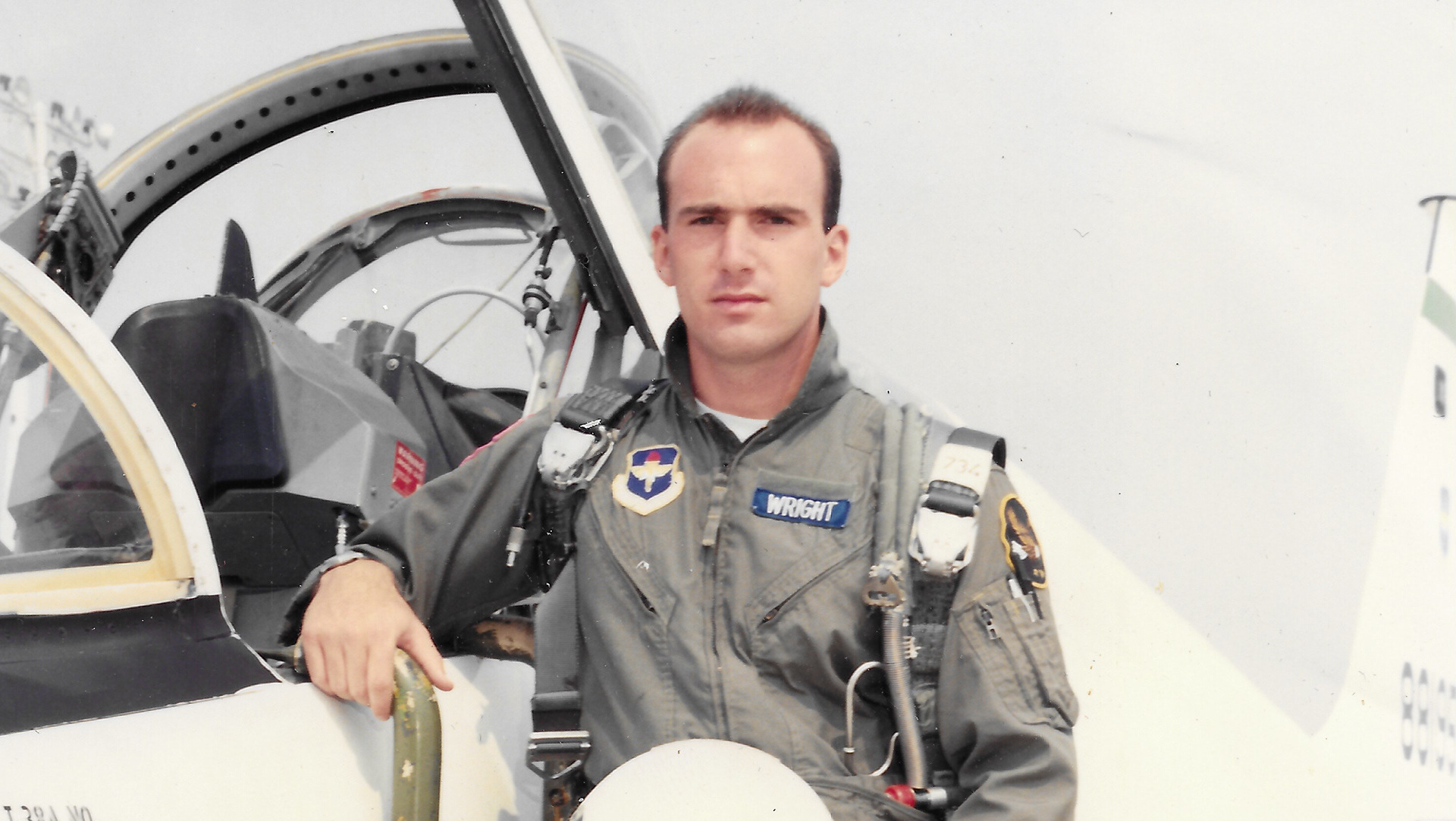
Daytona Beach, FL –
SPOILER ALERT! Only for those who have read my book!
After my dear friend Doley introduced me to my dear editor, Catherine Adams, The Inkslinger, the real heavy lifting began. If I was to convince her to work with me, I had to submit a 10-page essay to her detailing what my book was all about for her to consider my submission. “Well,” I thought, “what’s another ten pages?”
The following write-up differs slightly from what I initially shared with The Inkslinger, as I’ve modified it for people that reach out to me who tell me that their Book Club has selected my work for their monthly discussion. But I hope you find what I share to be insightful, and if you pick up my work for a second or third time, I hope this gives you a new appreciation for what you’ve read.
Enjoy!
I. Plot Level: If you ain’t a pilot, you are a failure.
The plot of If You Ain’t a Pilot… is not very complicated. With the goal of Undergraduate Pilot Training (UPT) being to graduate and become an Air Force pilot, the basic plot is fairly simple: If you ain’t a pilot, you are a failure. The struggle of the main character, me — and of all the students in Class 88-07 — is to graduate and become an Air Force pilot. The good guys are the student pilots. Relative to this plot, the bad guys are the instructor pilots to a certain degree, but more so, the pilots of a special group of instructors assigned to evaluate students, known as Check Section, are the main adversaries.
After being confined to a mountainside on the eastern slope of the Colorado Rockies for four long years as Air Force Academy cadets, my classmates and I were tired of rules, ready for our freedom, and fired up to fly jets to defend the freedom of others. What we didn’t see coming was that one year of flight school would be even harder than four years at the Air Force Academy, that not everybody who started UPT would finish it, and that not everybody who finished UPT would get a desirable flying assignment.
A wrinkle in the basic plot is the irony that even by graduating and becoming a pilot, there was a real possibility that students could be assigned to a number of undesirable aircraft and Air Force bases. Guarding against the threat of a Soviet attack at the end of the Cold War, most tanker and bomber bases were positioned far from the edge of humanity in desolate nowhere-lands of mosquitoes, moose, and fish. Another possible outcome was to graduate and then be assigned as an instructor pilot in Columbus, which almost nobody wanted. All I wanted to do was to fly a cargo jet at a base near a beach. Thus, the plot also involves not only graduating but not getting stuck with an undesirable assignment.
The climax of the action on this level occurs in the scene where I am flying my T-38 formation check ride against Beez. He puts me in a bad situation, and if it weren’t for the Check Section pilot taking control of the aircraft from me, I would not have been able to avoid a mid-air collision. Having had the jet ripped out of my hands, my classmates, instructors, and I all think I have failed the ride, and by failing this particular ride, it would be my third failed check ride and quite possibly the end of my flying career.
In the next scene, I reveal that I earned a passing grade because I’d applied the proper procedure when the unsafe situation occurred. The next scene also offers an important plot development on this level when I learn that I have earned a FAR (Fighter Attack Reconnaissance) rating, ranking me in the top half of the class, opening the door to the possibility that I will be chosen to become an instructor pilot and remain in Columbus.
The resolution to both pieces of this plot level are revealed in the scenes on Assignment Night. When I share the story of how I passed my last check ride with Skeletor, the most villainous of all Check Section pilots, I reveal to the reader that I have done enough to graduate from UPT, and I will become a pilot. Moments later, when I learn my assignment, I find out that I’ve been given an undesirable assignment. Though being named to remain in Columbus as an instructor pilot is not the assignment I wanted, however, I should have seen it coming. When Captain Fitzmorris asks me if I’m ready to buy his boat, a tired joke I’ve never found funny, I ask him, “How much?” This shows that I am ready to accept my fate.
Even though I suffer multiple setbacks, I try to keep the tone of the story positive and fun. First and foremost, If You Ain’t a Pilot… is a comedy, and in telling my story, I tried to include all the elements of a classic comedy. It is also a story about friendship, and while our class at Columbus Air Force Base, UPT Class 88-07, was a very tight group, the main relationships on which I focus are those with my best friends, Kenny, Doley, and Kurt. I try to include an anecdote about each one of these characters in every chapter. The humor in scenes with Kenny is usually off-the-wall and unexpected behavior from an Air Force officer. The humor in scenes with Doley is mostly when he makes fun of someone or something. The humor in the scenes with Kurt occurs when he candidly talks about life as a husband or father in ways that single guys cannot understand or do not want to know.
II. Theme Level: If you ain’t a pilot, you are not to be valued.
As the title of the story implies, If You Ain’t a Pilot… is very much a story about attitudes. The conflict with which my character wrestles in this layer of the story is the same Air Force adage on a different level: If you ain’t a pilot, you have less value than those who are. First, is it true? Next, if it is true, must it be so? The opposing sides on this theme are much less distinct than those on the basic plot level. In this layer of the story, there are those who accept this attitude and others who reject it from various groups of people. For example, not all instructor pilots think and treat students less than professionally, and not all students are bothered by not being treated with dignity and respect.
At the Air Force Academy, we were taught that after graduation, we would be military officers first and pilots second, but at Columbus Air Force Base, we are immediately introduced to the opposite doctrine, one that creates a very segregated environment. Throughout the story, I point out elements of segregation in the town of Columbus between Blacks and Whites in a matter-of-fact manner without really condemning either side. I am less overt, though much more critical, about the segregation that exists between pilots and non-pilots and male pilots and female pilots in the Air Force. I also take shots at religion, North-versus-South, and many other ways we define and divide ourselves as people, and for the most part, I attempt to do so through ridicule and sarcasm rather than through judgment and self-righteousness.
In the scene where I have a conversation about politics and life with an elderly man who was supposed to have mowed our lawn, I finally make the connection that segregated systems, like pilots and non-pilots, Blacks and Whites, male pilots and female pilots, etc., all result from one group having the aforementioned attitude, which could be more universally applied as: If you ain’t like me, you have less value than I do.
The climax of this theme in the story occurs just before my friends and I need to brief up a four-ship formation ride. Having just seen my T-37 instructor, Major Lawson, who has left the Air Force for a job as an airline pilot, my friends and I wonder why good people seem to leave the Air Force, and not-so-nice people remain. When Kurt suggests, “We can change it,” his statement is the rejection of this bad Air Force attitude and is meant to give hope for the future. I demonstrate that I also reject this manner of thinking when Smudgie, my instructor for our four-ship flight, one who embodies the “If you ain’t a pilot…” attitude, repeatedly tells me how I must say something he wants me to say. I purposely don’t say what he wants, which makes him go crazy.
III. Framework: To be a pilot, you must understand the Laws of Thermodynamics and the Law of Maximum Entropy Production.
I have always thought of my book as a story about chaos, illustrating the breakdown of systems from order to disorder. Entropy degrades just about every type of system mentioned throughout the story. Some examples of this: The civilian maintenance system breaks down, the training timeline breaks down, relationships that are not maintained break down, and even my digestive system breaks down when I don’t take care of it. This goes on throughout the story in various degrees right up to the scenes where my buddies and I drink tequila in Mark Jellicot’s van and I come up with the stupid idea that growing a mustache will make a difference in my future flying assignment. These scenes are intentionally completely ridiculous (and pathetically, they are pretty much true to what really happened).
For years, I had no idea how entropy could sustain a story or how entropy could allow me to arrive at an ending point. As cadets at the Academy, we joked about entropy and the Second Law of Thermodynamics, wondering, “If this Law were true, then why didn’t everything in the entire universe move from order to disorder, causing the universe to revert to total chaos?” At the time, our professors told us that the reason the world did not revert to total chaos was because the Laws of Thermodynamics only applied to closed systems.
What none of us knew at the time– and what nobody knew at the time, because the reason had not yet been codified– was how the Law of Maximum Entropy Production explained why the world did not revert to total chaos. This Law was not recognized until 1988 and not articulated in its present form until 1989. I graduated from college in 1987 and finished flight school in 1988. I didn’t even know this Law existed until about ten years ago, when I was doing research for my book.
The Law of Maximum Entropy Production (LMEP) is as follows:
“A system will select the path or assemblage of paths out of available paths that minimizes the potential or maximizes the entropy at the fastest rate given the constraints.” (http://www.lawofmaximumentropyproduction.com/)
The LMEP made me realize that both the joke we asked as cadets about entropy and the answer our instructors gave out at the time were wrong. Entropy is not an on-going process. Systems do not continuously move toward a more disorderly state. Instead, systems move to maximum disorder as fast as they possibly can until they run up against constraints that prevent them from further chaos, or the entropy has been maximized.
This law also states that systems move to minimize potential as fast as possible, and this ties directly into the segregation themes. Even though Air Force officers are supposedly officers first and pilots second, the pervasive attitude of “If you ain’t a pilot, you ain’t shit” minimizes the potential of non-pilots and results in a segregated system. Likewise, even though the story takes place two decades after the Civil Rights Movement, and people of all races are equal under the law of the land, the attitude that Blacks and Whites don’t mix effectively minimizes potential of one group relative to the other and again results in a segregated system. In spite of the promise of a system of equality, the LMEP explains how attitude is a sufficient constraint upon people to allow one group to keep another in check.
After learning about the LMEP, I realized I had my framework for my story, because this Law allows me to relate a tale of entropy and still wrap it up with an orderly ending. Thus, I weave in the Laws of Thermodynamics, the rules that govern how heat and energy behave within systems, and I include the LMEP as the framework for my story to explain why system degradation occurs and to provide a strategy for managing entropy.
The opening line of the book, “You can’t fart with impunity while a ceiling fan spins overhead,” is a clue that these laws and the LMEP play a major role in the book. If someone were to read my opening sentence and ask, “Why not?”, he or she would understand the concepts of equilibrium, transfer of heat and energy, entropy, and the constraints of the fan blades blowing air back in one’s face are all reasons why one cannot.
The scene in which my friends and I are fitted for our flight helmets at the beginning of our training is another microcosm for this level of the story. Because Kurt’s head is too big for the standard helmet mold-making apparatus, the helmet makers piece together an ill-fitting mold-maker with very poor constraints. As the chemicals are combined in the makeshift mold and begin to expand, the mixture oozes through the holes in the mold as fast as it possibly can because the constraints are not very good.
The Zeroth Law of Thermodynamics, that of thermal equilibrium, is introduced when Captain Wright tells Doley and me why he prefers cold beer to free beer. The concept of equilibrium, though not thermal equilibrium, is also presented in the scene in the altitude chamber, where students practice the One Cheek Sneak to equalize gastric pressure, and I am worried that I may not be able to equalize the pressure in my inner ear upon descent from altitude.
The First Law of Thermodynamics, a version of the conservation of energy, is explained partially to me by my T-37 instructor, Lieutenant Wilson, and fully to me by my T-38 instructor, Lieutenant Baiber, who mentions the law by name. There is a finite amount of energy. It can neither be created nor destroyed. You can use it wisely, or you can waste it, and the best pilots manage their energy to make the most of their time in the sky.
The Second Law of Thermodynamics is mentioned by name during the formation phase of T-38 training. When I say to Captain Schipp, “it seems to me like the flights are never flown the way they are briefed,” he tells me that the Second Law of Thermodynamics is the reason they never will be. Not only do the best laid schemes often go awry, but according to the Second Law, they always go awry, which is the heart of my story. Rather than leave me in despair, distraught that I will never fly the perfect ride, Captain Schipp provides a strategy for combatting entropy, which is preparation for a way to get back to one’s plan.
The Third Law of Thermodynamics, dealing with the concept of absolute zero, is invoked when I try to remove a tray of ice cubes from the freezer in our kitchen and cannot do it, because the temperature in the icebox has become like absolute zero. While the Third Law of Thermodynamics is not a major point of emphasis within the story, it is the ultimate punchline on the level of the story that deals with Ginsberg’s Law, a twist on this particular level of the story.
Finally, the LMEP is introduced in my conversation with the astronaut in the flight planning room at the Johnson Space Center in Houston. He affirms what Captain Schipp has told me about preparation being one way to battle entropy, but he goes even farther to tell me that if I have the proper constraints in place, I might even be able to prevent entropy. I cannot mention the LMEP by name in my story, because it hadn’t been articulated when I was a student pilot in 1987 and 1988. However, the astronaut pretty much recites this law to me word for word.
Whereas the Second Law of Thermodynamics is a law of despair, stating that systems fall apart over time, the LMEP states that not only do things fall apart as fast as possible, but once they have done so, order is restored. That is, the world is in the order production business. The LMEP also dictates that it is possible to keep things from falling apart, if one has put the proper constraints into place beforehand. Therefore, I can credibly relate a tale where everything feels like it wants to dissipate into chaos yet I can wrap it all up neatly in a world that once again has order. The LMEP allows me the positive outcome I wish to convey.
Having shared how the Laws of Thermodynamics and the LMEP frame the story, I’d like to make you aware of a few other devices employed throughout the work.
Flashback: The story, as presented in the manuscript, begins in media res, so that the anecdotes retold up until the week before Assignment Night can be done in a non-linear narrative, grouped around a particular theme. If told chronologically, the events of the first chapter ought to be presented just prior to what is now the penultimate chapter. I do refer to my six check rides in the order they occurred.
Double entendre: Nearly every chapter title is a double entendre, and I consciously try to employ some form of misdirection in each chapter, as the anecdotes are currently grouped, to lead the reader to believe each chapter is about something I readily reveal, when really it’s about something else. For example, “Funky Chicken” refers to the cigarette ash in my chicken salad, but pilots will know it refers to what happens when one experiences a G-force induced loss of consciousness (or G-LOC; see an example of the funky chicken here: https://www.youtube.com/watch?v=eMjjGgRLG8k). The rap trio of Kenny, Doley, and me is also called Funky Chicken, which I don’t think any reader, pilot or not, would see coming.
Another example from a chapter title is “Souls of Men.” All Air Force Academy graduates, and a handful of non-grads, will know this phrase from the second verse of the Air Force Song…
Souls of men dreaming of skies to conquer
Gave us wings, ever to soar!
I even have Kurt Spranger say to me, “we’ve got skies to conquer.” Trickery! This chapter title is directed more at the souls of men who have circumvented the Civil Rights Movement to perpetuate a segregated educational system through the use of private academies and the souls of Air Force officers, like Smudgie, who treat people poorly.
Hyperbole: This may be a bit of an over-exaggeration, but I purposely use mostly first names when I talk about student pilots and rank-with-last-names when I talk about instructor pilots. In practice, many instructors referred to student pilots only by last name, and likewise, when students spoke about instructors, we used only last names. I add this layer of formality with instructors as a device to help draw the line between instructors and students. Even though we were all Air Force officers, there was a deep chasm between these two groups. Our instructors were like our big brothers in that they could be our heroes one minute and our enemies the next. In my initial drafts, the feedback I got from my beta-readers was that I needed to show a clear divide between students and instructors.
IV. Metaphorical Level: If you ain’t a pilot, you are not in control of your life.
Getting back to the various levels of meaning of If You Ain’t a Pilot…, on the metaphorical level, if you ain’t a pilot, you are not in control of your life. The jet in my story, whether it is a T-37 or a T-38, represents a person’s life. Do you fly it in the direction you want to go, or are you simply a passenger along for the ride? Either way, on this level of the story being a pilot is representative of a person being in control of his or her own life.
The conversations around energy management, entropy, and other thermodynamic principles are as much discussions about life as they are about flying jets. In one such discussion with Lieutenant Baiber, he tells me, “You’re not doing a good job managing your energy.” Doley then adds, “Lieutenant Wright wastes a lot of energy.” When the astronaut teaches me the LMEP, I ask him if he’s alluding to the Challenger disaster, but it’s not just about that. Like my other instructors before him, he’s giving me a prescription for life.
To successfully operate in any system, you need to understand that systems want to break down, use your energy wisely, put constraints in place to prevent the system from breaking down when it tries to do so, and have a plan for getting back in control when systems do break down. Otherwise, you are only along for the ride, you are bound by the limits that define or constrain the system, potential energy is quickly drained, and entropy is maximized. This is not only true of flying jets but of everything. Diet, fitness, yard work, relationships, studies…, I address all of these within this framework.
I stumbled upon Ginsberg’s Theorem when I was researching the Laws of Thermodynamics, and as challenging as the Laws of Thermodynamics may be to understand, the poet Allen Ginsberg’s parody of them summarizes my character’s plight perfectly. Rephrasing the first, second, and third laws as if they applied to a game, he stated:
1. You can’t win.
2. You can’t break even.
3. You can’t even get out of the game.
Because I’m serious about nothing and treat everything I do like a game, when I learned about Ginsberg’s Theorem, I had my hidden meaning. I scatter references to this parody throughout the story, and I refer to games in chapter titles and within my writing. At the end of the story, while I do graduate from UPT, I am assigned to be a FAIP, a First Assignment Instructor Pilot, stuck in Columbus, Mississippi. Although I take control of the jet, a metaphor for taking control of my life, the story ends with me being stuck in a holding pattern, destined to remain at Columbus Air Force Base, bound by Ginsberg’s Theorem.
At the end of my story, I offer hope for the Air Force, when Kurt says, “We can change it,” and I offer hope for my character, when I say, “I have the aircraft.” Major Carrington doesn’t ask me if I’m ready to fly; he says, “let me know when you are ready to take control.” I shake the stick of the jet to take control.
The ending scene, as depicted, is the live action version of the Haiku poem I presented to Lieutenant Wilson much, much earlier in the story. Nearly 30 years after I actually presented this Haiku, “Transfer of Control,” to my instructor pilot, I thought it was the perfect way to end my story and tie a number of themes together. If readers were to go back to the Haiku scene after they’d finished reading the book, they’d see that I reveal the metaphorical meaning to my story when I tell Lieutenant Wilson what my Haiku is all about.
“Sir, in ‘Transfer of Control,’ the taker character is someone who has not been in control. For whatever reason, someone or something else is in control. This is not to say that the taker is necessarily out of control, but clearly, prior to taking control, the taker has not had control. Only when the taker shakes, an action of change, does the taker take control and no longer not have control. I think it’s as powerful an ending as the last line of ‘High Flight.’ Don’t you agree?” I asked.
“Not really,” Lieutenant Wilson said.
At the end of the story, I have not only come to the realization that I must stop going along for the ride, that I must manage my energy more efficiently, and that I must take control, but by shaking the stick of the jet, I acknowledge that I am taking control. My training is done, I am a pilot, and I am taking control of my life as opposed to allowing myself to be defined by the constraints of a particular system.
Just like Lieutenant Wilson did not understand the meaning behind my Haiku after I’d explained it to him, I fully expect that those readers who only see If You Ain’t a Pilot… on the comedy level or the basic plot level will not understand the ending, and this takes us back to Arnold Sommerfeld’s quote at the beginning:
“Thermodynamics is a funny subject. The first time you go through it, you don’t understand it at all. The second time you go through it, you think you understand it, except for one or two small points. The third time you go through it, you know you don’t understand it, but by that time you are so used to it, it doesn’t bother you anymore.”
Since I envision my story as an allegory that is presented upon the Laws of Thermodynamics, if readers don’t understand this ending, I’m quite okay with this. As long as readers have been entertained along the way and find the story to be a funny subject, like Sommerfeld says, I don’t think it will bother them.
V. Summary: If you ain’t a pilot…
In summary, If You Ain’t a Pilot…, my occasionally embellished collection of happy memories with great friends, seeks to make people laugh. It is a coming-of-age tale told through my experiences while training to become an Air Force pilot. Using segregated environments as backdrops, it is a story about systems that offers moral commentary about attitudes and the way people treat one another. Those who believe “If you ain’t a pilot/male/female/White/Black/Southerner/Yankee/military/civilian, you ain’t shit” slap a systemic constraint upon those not like themselves and minimize the potential of others.
Just as I’ve shared with you that I’ve tried to use double entendre and misdirection in choosing my chapter titles, the same is true with the title of the book. This story is not meant to affirm the adage, “If you ain’t a pilot, you ain’t shit.” For people who think it is, the joke is on them. This story is my ridiculing and rejecting the “If you ain’t a pilot…” attitude. For me, if you ain’t a pilot, I’m okay with that. You still have value, and you deserve to be treated with respect. Even though I am a pilot, I will do so.